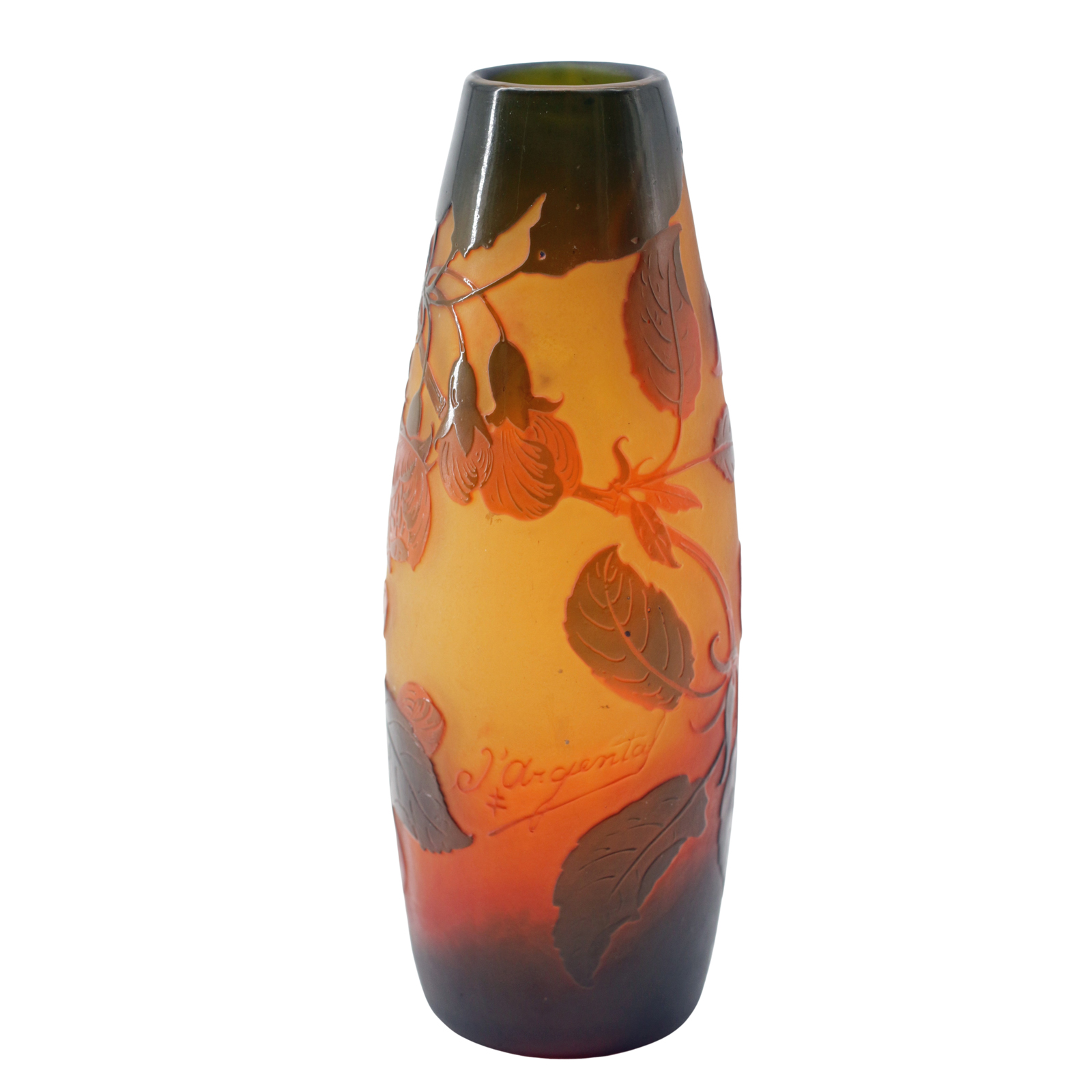
Sometimes an antique tells you where to begin. On this vase, the clue is written directly into the glass: D’Argental.
The tall, tapering vessel is decorated with layered botanical forms in warm amber, orange, brown, and deep green. Leaves and hanging seed or flower forms move across the surface, while darker layers frame the rim and base. Near the lower portion of the body is the signature that opens a much larger story.
Who Was D’Argental?
D’Argental was not the name of a single anonymous glass factory. It is closely associated with the independent career of Paul Nicolas, one of the important glass artists to emerge from the celebrated artistic environment of Nancy, France.
Nicolas was born in 1875 and entered the firm of Émile Gallé in the early 1890s. According to the Musée de l’École de Nancy, he worked initially as a decorator, draughtsman, and varnisher and became particularly involved in the floral decoration of Gallé glass. Over time he learned a much broader range of glassmaking techniques. :contentReference[oaicite:0]{index=0}
That apprenticeship matters. Gallé was one of the defining figures of French Art Nouveau, and his workshops helped turn Nancy into an international center for decorative glass. Nicolas therefore learned not merely a manufacturing process, but an artistic language built around nature, botany, layered glass, color, and surface decoration.
From Gallé to His Own Workshop
In 1919, Nicolas left the Gallé firm and established an independent operation with fellow former Gallé craftsmen Pierre Mercier, Émile Villermaux, and Eugène-Henri Windeck. The group became known as the Graveurs Réunis.
Their enterprise had an important partner: Cristalleries de Saint-Louis. Saint-Louis supplied the undecorated crystal forms, while Nicolas and his associates carried out the decoration in Nancy. Contemporary museum documentation specifically records this relationship between Nicolas, D’Argental, and the Saint-Louis-lès-Bitche works. :contentReference[oaicite:1]{index=1}
Saint-Louis itself was already one of France’s great crystal houses. Its history reaches back to 1586, and the manufacture became the Royal Glassworks of Saint-Louis in 1767. The company also identifies Paul Nicolas among the artists who contributed to its twentieth-century design history. :contentReference[oaicite:2]{index=2}
The D’Argental Signature
Nicolas initially marketed work under the D’Argental name. These early independent pieces remained strongly connected to the traditions of the École de Nancy: naturalistic decoration, layered glass or crystal, contrasting colors, and acid-etched botanical motifs.
By the later 1920s, Nicolas increasingly signed pieces with his own name, usually P. Nicolas, sometimes adding “Nancy” or the Cross of Lorraine. That progression makes the signature useful when placing his work within the broad arc of his career. :contentReference[oaicite:3]{index=3}
The Vase in Front of Us
The submitted vase fits naturally into that D’Argental world. Its form is relatively simple, allowing the decoration to do most of the visual work. Layered colors create depth, while the plant forms emerge through the contrast between the different layers of glass.
The decoration is unmistakably botanical. That is especially appropriate in the context of Nicolas. The Musée de l’École de Nancy notes both his abilities as a draughtsman and his deep interest in botany—an interest that helped bring him to Gallé’s attention in the first place. :contentReference[oaicite:4]{index=4}
The image also demonstrates why attribution in decorative glass often goes beyond simply reading a signature. Form, palette, technique, subject matter, and the relationship between the decoration and the body of the vessel all contribute to the picture.
More Than a Gallé Follower
It would be easy to describe Nicolas simply as a former Gallé artist, but that understates his career.
After becoming independent, he gradually moved beyond the naturalistic Art Nouveau vocabulary of his early work. His later pieces increasingly explored stylization, abstraction, crystal itself as a material, and the emerging influence of Art Deco. He also worked with a remarkably broad range of techniques, including acid etching, wheel engraving, enameling, wheel cutting, hot applications, and internal decoration. :contentReference[oaicite:5]{index=5}
His work received recognition at major international exhibitions during the 1920s and 1930s, yet his name never achieved the broad public familiarity of Gallé or Daum. The Musée de l’École de Nancy has described him as an important Lorraine glassmaker whose reputation deserves greater recognition. :contentReference[oaicite:6]{index=6}
Why This Vase Matters
That is what makes an object like this more interesting than its identification alone.
A signature that may initially appear to be simply a maker’s mark connects the vase to Gallé, the École de Nancy, Saint-Louis, the transition from Art Nouveau toward Art Deco, and the independent career of an artist who spent decades exploring what decorative glass could become.
The object is therefore not merely “a French cameo glass vase.” It is a point of entry into a much larger story.